My subscription to Life expired, but I still have a subscription to Mad.

Tuesday, May 21, 2019

AM Radio at Dawn on I-80


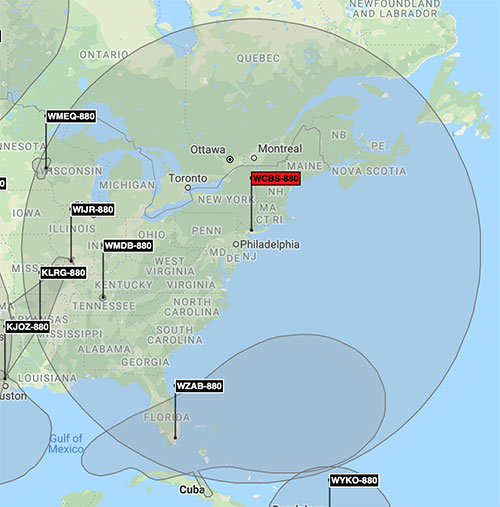
The second leg of my drive home from Hamvention began at 6 AM, about 5 minutes before sunrise on Monday morning in Hubbard, Ohio. Since nighttime propagation was still in effect, I was curious as to what the AM flamethrowers on the East Coast sounded like in the Midwest.

First, I tuned to 880 to listen for WCBS. My favorite news station was in and out vying with an unidentified religious station.

Next, I tuned to 1010 to listen for WINS, my other favorite news station. I was surprised to find 1010 completely dead.

I tuned up to 1080, the home of WTIC, my local flamethrower and it was loud and clear with no sign of another station on frequency. I was impressed.

1700 was my next target. Hoping to hear WJCC – not a flamethrower, but a 1 kW FLA station I heard mobile in Connecticut. Instead, I found the reborn WRCR with a weak, but solid signal.

I tuned back to 880 to see how WCBS's signal behaved as the sun rose. For nearly a half hour, WCBS hung in there. Most of the time, it was very weak, but occasionally, it was solid for a minute or two. It finally dropped out of sight at about 6:45. I did not hear WCBS again until I was in Eastern Pennsylvania four hours later.

Sunday, May 12, 2019

First Es at KA3JAW

WSMR RDS on KA3JAW's Sony HD XDR-S3HD Receiver Display

Mike Schaffer, KA3JAW, reported his first 2019 'in-season' FM-DX reception via Es.

On Friday, May 10, from 10:55 AM to 12:14 PM EDT, Mike heard and saw (RDS text) classical station WSMR on 89.1 FM in Sarasota, Florida, from 1,023 miles distance to Easton, Pennsylvania, via Sporadic-E.

Prior to the reception of WSMR, at 9:35 AM EDT, the MUF was 77 MHz over Maidenhead grid square FM07 (Lynchburg, Virginia) when he was hearing Alabama, Florida and Georgia on the Citizen Band Radio Service (27 MHz/11 meters).

At 11:30 AM EDT, 88.3 WPOZ in Orlando, Florida, also with RDS was received via Sporadic-E.

At 11:59 AM EDT, the MUF rose to 95 MHz above FM06 (Roxboro, North Carolina).

KA3JAW's antenna is an outdoor Antennacraft Y526 designed for VHF-low band TV that is only 114 inches (9.5 feet) off the ground, just 4 inches past the peak of his backyard shed roof, aimed south-southwest. This proves you do not need a high antenna on a tower to receive FM-DX via Es as the signal path is coming in on a low radiation angle.

Mike has posted a couple of videos on YouTube documenting Friday's DX, here and here.

Thursday, May 9, 2019

Hamvention Bound

This time next week, I will be in Ohio to attend Hamvention.

I will be making a short presentation at the TAPR Forum, which starts Friday morning at 9:15 AM in Room 1. Also, I will be staffing TAPR's booths (Building 5, booths 5001-5003) throughout the weekend and attending the TAPR-AMSAT Annual Banquet Friday evening.

If you will be attending Hamvention, I hope to see you there!

Monday, April 29, 2019

PSR #141 is Available

The Spring 2019 issue (#141) of TAPR's quarterly newsletter, Packet Status Register (PSR), is now available for downloading here.

Friday, April 26, 2019

Productive Week

This has been a very productive week so far adding three new stations to the log on Tuesday and one each on Wednesday and Thursday.

Wednesday at 2257Z, I added WGIR on 610 kHz transmitting 5 kW from Manchester, New Hampshire, 122 miles to the northeast.

Thursday at 2329Z, I added WCMA on 900 kHz transmitting 700 watts from Brunswick, Maine, 216 miles to the northeast.

Equipment used were an ICOM IC-R8600 receiver and an ICOM AH-7000 discone antenna.

The 2230Z to 2359Z time period which brackets local sunset (2345Z) has some interesting propagation and has permitted me to log some interesting stuff.

After dinner, I go to the shack, power up the radio and tune to a frequency that is dead quiet or has a very weak signal dropping above and below the noise. As sunset approaches, the station gets stronger and may be joined by other stations.

For example, Thursday evening, WCMA was in the mud for awhile and I could not identify it. Then it was joined by CHML, which was building up in strength getting ready to dominate 900 kHz for the night. I am just hoping that WCMA can hang in there long enough for an ID. Finally, WCMA makes its last stand and is strong enough for about a minute to overcome CHML and clearly identify itself!

Lots of fun!