My subscription to Life expired, but I still have a subscription to Mad.

Showing posts with label WTIC. Show all posts

Tuesday, August 13, 2024

WCBS 880 Going Away

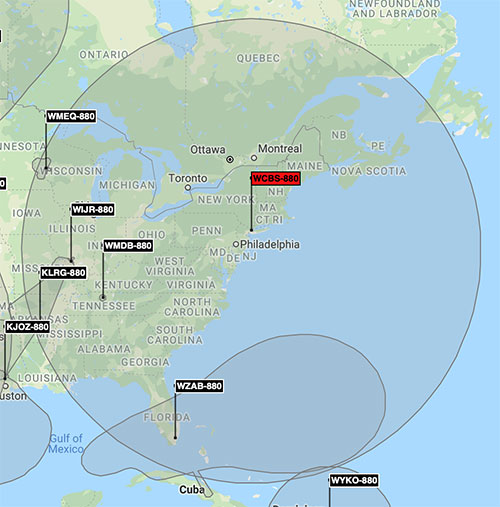
ESPN is shutting down all-news radio station WCBS, 880 kHz in New York City. Although we live 68 miles from the WCBS transmitter, it is like a local station here and it is my station of choice in the Subaru. It will be a sad day when they finally pull the plug at WCBS.

Although it has been one of my favorite stations for a long time, I only wrote about it here once. In honor of WCBS’s imminent demise, I am repeating that May 2019 post here now.

AM Radio at Dawn on I-80

The second leg of my drive home from Hamvention began at 6 AM, about 5 minutes before sunrise on Monday morning in Hubbard, Ohio. Since nighttime propagation was still in effect, I was curious as to what the AM flamethrowers on the East Coast sounded like in the Midwest.

First, I tuned to 880 to listen for WCBS. My favorite news station was in and out vying with an unidentified religious station.

Next, I tuned to 1010 to listen for WINS, my other favorite news station. I was surprised to find 1010 completely dead.

I tuned up to 1080, the home of WTIC, my local flamethrower and it was loud and clear with no sign of another station on frequency. I was impressed.

1700 was my next target. Hoping to hear WJCC – not a flamethrower, but a 1 kW FLA station I heard mobile in Connecticut. Instead, I found the reborn WRCR with a weak, but solid signal.

I tuned back to 880 to see how WCBS's signal behaved as the sun rose. For nearly a half hour, WCBS hung in there. Most of the time, it was very weak, but occasionally, it was solid for a minute or two. It finally dropped out of sight at about 6:45. I did not hear WCBS again until I was in Eastern Pennsylvania four hours later.  

Sunday, March 19, 2023

Is WTIC 's IBOC Gone for Good?

WTIC's IBOC'd signal extended from 1065 to 1095 kHz!
Living 13 miles line-of-sight of WTIC’s 50,000-watt transmitter site on 1080 kHz makes DXing on 1070 and 1090 kHz very difficult especially since WTIC uses IBOC (In-band on-channel), a hybrid method of transmitting digital radio and analog radio broadcast signals simultaneously on the same frequency. 

With IBOC on, I can’t hear a thing but IBOC on 1070 and only 50,000-watt WBAL manages to break through on 1090.

Good news is that it seems that WTIC is no longer using IBOC. It has been off for weeks (maybe months) and I hope it is not coming back. 

Hurrah!

Saturday, November 6, 2021

Fun on 1080

Friday at 2150 UTC, I turned the radio on and randomly tuned up the AM band from 860 kHz. When I arrived at 1080 kHz, I found no one there! I live 12 miles from the transmitter site of WTIC, a 50,000-watt IBOC station on 1080 and because of that proximity, I have never logged another station on 1080 except WTIC. I don’t know why WTIC was off the air, but here was an opportunity to log something new on 1080.

Initially, I heard nothing except splatter from WBAL on 1090. Gradually, a gospel station starting building strength, but I never heard a station ID, nor could I match it with any AM radio simulcasts on the Internet. 

A second station appeared, a religious station with a preacher preaching. The signal eventually came up. There was no station ID, but I did match it exactly with WWNL’s Internet simulcast. WWNL is located in Pittsburgh transmitting 25,000 watts west-southwest of this location.

WTIC returned to the air at 2232 UTC with no mention as to why it was off the air,

It was fun while it lasted!

Earlier in the week, Wednesday at 0545 UTC, I logged a new one on 550 AM: WAME in Statesville, North Carolina, transmitting 53 watts, 586 miles to the southwest.

The WAME logging was better DX than the WWNL logging, but the WWNL logging was a once in a lifetime (so far) logging!

Monday, January 4, 2021

WTIC's IBOC and WWCO's absence

Before turning in last night, I tuned the AM band to hear what I could hear and came up with a couple of surprises.

WTIC on 1080 kHz, 50,000 watts, 13 miles line-of-sight from my home, seems to have turned off its IBOC, which made reception on 1070 and 1090 kHz difficult, if not impossible. I noticed this when I turned to 1070 and could actually hear stations without having to use my receiver's filters to tune out WTIC's IBOC. I checked again this morning and the IBOC was still off, but it had returned when I checked again this afternoon. It was nice while it lasted.

Tuning further up the band, I noticed that 1240 kHz was absent WWCO's signal (1000 watts, 7 miles from my home). I cannot receive anything but WWCO on 1240 when it is on the air, but last night, there was a cacophony of stations on 1240 typical for a graveyard channel.

I decided to forgo sleep and take advantage of this rare opportunity and try to identify something. Briefly, WFTN popped up for identification – a new one for the log. (WFTN transmits 1000 watts from Franklin, New Hampshire, 142 miles to the north-northeast.)

I hung around for about 15 minutes more until WWCO came back to life and dominated 1240.

Receiver: ICOM IC-R8600, Antenna: 128-ft Loop on Ground (LoG)

WTIC's IBOC'd signal extends from 1065 to 1095 kHz!

Saturday, August 22, 2020

WCSZ Logged


Got the word Friday that WCSZ on 1070 kHz in Sans Souci, South Carolina, 693 miles to the southwest, would be running test transmissions at 0400 UTC Saturday.

I live line-of-sight of WTIC’s 1080 kHz, 50,000 watt transmitter. That’s bad enough, but WTIC also uses IBOC, which interferes with signals on 1070 and 1090, so I had my doubts about hearing WCSZ, but since my bedtime these days is about 0400 UTC, I planned to listen anyway.

The ELAD FDM-S2 SDR receiver was my receptor of choice. I tuned it to 1070 and switched to USB because the WTIC IBOC runs strongest between 1064.6 and 1070 (see figure), then drops in strength above 1070. I also narrowed the bandwidth down to 2800 Hz (represented by the vertical red bar in the figure).

At 0400 UTC, I heard station audio way down in the mud – so far down in the mud that there was no way I could identify it. But at 0404, clear as a bell, I heard Morse code: V V V DE WCSZ WCSZ WCSZ.

With that, I shut down the station, entered WCSZ in the log and went to bed.

WCSZ may have been transmitting either 25 or 50 kW for the test when I heard it.

Also, it is interesting that at the time, 50 kW WBAL (254 miles to the southwest) was stronger than 50 kW WTIC (12 miles to the north-northeast).


Tuesday, May 21, 2019

AM Radio at Dawn on I-80


The second leg of my drive home from Hamvention began at 6 AM, about 5 minutes before sunrise on Monday morning in Hubbard, Ohio. Since nighttime propagation was still in effect, I was curious as to what the AM flamethrowers on the East Coast sounded like in the Midwest.

First, I tuned to 880 to listen for WCBS. My favorite news station was in and out vying with an unidentified religious station.

Next, I tuned to 1010 to listen for WINS, my other favorite news station. I was surprised to find 1010 completely dead.

I tuned up to 1080, the home of WTIC, my local flamethrower and it was loud and clear with no sign of another station on frequency. I was impressed.

1700 was my next target. Hoping to hear WJCC – not a flamethrower, but a 1 kW FLA station I heard mobile in Connecticut. Instead, I found the reborn WRCR with a weak, but solid signal.

I tuned back to 880 to see how WCBS's signal behaved as the sun rose. For nearly a half hour, WCBS hung in there. Most of the time, it was very weak, but occasionally, it was solid for a minute or two. It finally dropped out of sight at about 6:45. I did not hear WCBS again until I was in Eastern Pennsylvania four hours later.

Thursday, October 11, 2018

CBI and WTIC


Entered radio station CBI in the log Thursday evening. The Sydney, Nova Scotia station transmits 10,000 watts on 1140 kHz, 703 miles to the northeast. Equipment used was an ICOM IC-R8600 receiver and a Hy-Gain 18AVT/WB-A vertical antenna.

Bad news is that WTIC AM on 1080 kHz is back to full power and is stronger than ever here 16 miles from its 50,000 watt transmitter. Actually, their signal and IBOC crud seems worse than ever and occupies over 30 kHz of radio spectrum!

Tuesday, October 2, 2018

Oh, What a Night!

I spent about an hour (2230 to 2330 UTC) last night tuning up and down the AM/MW band and noted more transatlantic carriers than I ever recall hearing before and one new station for the log on a frequency where I seldom expect to find anything!

Tuning from 530 to 1710, I was very surprised to clearly hear a station on 1070. Usually all I hear on 1070 is slop from WTIC on 1080, but last night I found WPLB with an S-9 signal. WPLB, "Mid Century Radio," is a daytimer located in Plattsburg, New York, transmitting 5,000 watts 207 miles to my north.

Examining WTIC's signal on my IC-R8600's spectrum scope, it was obvious that WTIC's signal was not as wide and strong as it normally appears here (16 miles from their 50 kW transmitter). Was there a problem with their transmitter or antenna? Did they shut down their IBOC? Dunno, but I will keep checking their signal to see if the change was temporary or permanent.

Meanwhile, I noted the following 23 "transatlantic" carriers, an amazing number (to me): 531, 549, 567, 684, 693, 774, 855, 936, 954, 963, 1008, 1044, 1053, 1152, 1179, 1215, 1278, 1296, 1305, 1539, 1584, 1593, 1602.

Comparing my collection of carriers with WA1ION's recent loggings from Cape Cod (142 miles to my east), I presume I heard the following station carriers:

531 - Algeria, F'Kirina, Radio Algerie
549 - Algeria, Sidi Hamadouche, Radio Algerie
567 - Spain, Murcia/Torre de Cotillas, Radio Nacional de España, Radio 5
684 - ?
693 - United Kingdom, BBC, Radio 5
774 - Spain, València/El Palmar, Radio Nacional de España, Radio 1
855 - Spain, Murcia/Torre de Cotillas, Radio Nacional de España, Radio 1
936 - Morocco, Agadir/Aït Melloul, SNRT (Société nationale de radiodiffusion et de télévision)
954 - Spain, Madrid/Pozuelo de Alarcón, Radio Onda Cero
963 - ?
1008 - ?
1044 - Spain, San Sebastián/Monte Igueldo, Sociedad Española de Radiodifusión (Spanish Broadcasting Company)
1053 - United Kingdom, Droitwich/Mast, talkSPORT
1152 - ?
1179 - ?
1215 - United Kingdom, Moorside Edge, Absolute Radio
1278 - ?
1296 - ?
1305 - ?
1539 - ?
1584 - ?
1593 - ?
1602 - ?

Equipment used here were an ICOM IC-R8600 receiver and a Hy-Gain 18AVT/WB-A vertical antenna.

What a night!

Sunday, April 29, 2018

IC-R8600's Digital Twin Passband Tuning


There is a handful of nearby AM radio stations that are very strong here and sometimes make it difficult to hear stations on adjacent frequencies, for example, WPRX on 1120 kHz running 1000 watts 2 miles away, WNTY on 990 kHz running 2500 watts 5 miles away and WLAT on 910 kHz running 5000 watts 8 miles away. But by far, the worst is WTIC on 1080 running 50,000 watts line-of-sight 16 miles away. Its 50 kilowatts are bad enough, but it also uses IBOC, which dumps hash on 1070 and 1090 that is 20 over 9.

Despite the hash, I have managed to bag seven stations on 1070 by rotating my radios and/or antennas to null WTIC's signal.

I wondered if my new whiz-bang ICOM IC-R8600 could handle WTIC's IBOC hash. Studying the IC-R8600 manual, I thought that the radio's "Digital Twin PBT" might solve the problem.
"The Digital Twin PBT (Passband Tuning) electronically narrows the IF passband width by over wrapping the passband frequency ranges of 2 PBT filters (PBT1 and PBT2), to reject interference."
So I saddled up to the radio last night around 2330 local time, powered up the IC-R8600 and found Radio Havana loud and clear on 530 kHz, so conditions were very good and WTIC's IBOC hash would be very strong. Tuning to 1070, all I could hear was the IBOC hash.

I selected the Twin PBT option and began adjusting the two PBT filters (see figure above). In less than a minute, the IBOC hash gave way to The Eagles singing "Already Gone" on CHOK in Sarnia, Ontario!

Twin PBT did the trick!

Friday, December 16, 2016

WTIC on 161.76 MHz


Wednesday evening, I was listening to the local NOAA weather station on 162.4 MHz (WXJ42 in Meriden) with the ELAD FDM-S2/SW2. The waterfall display showed activity on all seven NOAA weather channels, which is typical from my location. I also noticed another signal down the band a ways... on 161.76 to be exact.

I tuned in the signal and was surprised to hear the voice of Joe D'Ambrosio, who does a sports talk show on WTIC AM (1080 kHz). It sounded like he was doing the show on the air, but on FM instead of AM and on 161.76 instead of 1080. So I grabbed the nearest transistor radio and tuned it to WTIC AM. Lo and behold, there was Joe D doing his show, but delayed by about 15 seconds from what I was hearing on 161.76.

My initial thought was that I was hearing a radio relay from the WTIC studio to the WTIC transmitter.  The studio is in the valley below my QTH about 6 miles away, while the transmitter is 12 miles away.

I revisited 161.76 MHz Thursday evening and the signal was still there, but now the volume of the signal's audio was low. After about 15 minutes, the volume of the signal's audio jumped up in strength as its contents changed from talk radio to news. This just confused matters.

Researching the mystery, I found in the 1994 edition of the Connecticut Scanner Guide that 161.76 was assigned to Chase Communications. Chase was the previous owner of WTIC, so that made sense.

How they are using 161.76 is still a mystery. I am sure there is a simple explanation, but I don't know what it is.

Tuesday, October 27, 2015

Two New Ones


Monday evening, I finally identified the Spanish language station on 920 kc: WURA transmitting 7 kW from Quantico, Virginia, 310 miles to my southwest. The station was very weak, but solid until sunset when it switches to 750 watts and lets WHJJ and CKNX vie for 920.

At 1056 UTC Saturday, I caught the station id of WKMB transmitting 250 watts from Stirling, New Hersey, 100 miles to my southwest. This was a nice catch because it was on the often difficult 1070 kc... difficult due to the IBOC QRM from the 50-kW WTIC on 1080 kc, 15 miles to my northeast.

Both new ones were captured using the Elecraft KX3 with the Terk Advantage antenna.

Thursday, September 24, 2015

Taylor Swift and My KX3


In May, I bought an Elecraft KX3 radio kit with almost all the options at Hamvention. Out of stock in Dayton, Elecraft shipped the kit to me and it arrived about two weeks later.

After some confusion on my part about receiving some wrong hardware, I built the kit and as I wrote here, I initially thought the receiver was deaf. Elecraft came to the rescue and had me install the default configuration file because I probably messed up some settings that deafened the receiver.

As I wrote back in June, "the receiver came to life after loading the defaults," but despite what I wrote, I still thought that the receiver was not that receptive and not living up to its reputation.

My spouse and daughter went to Gillette Stadium to see Taylor Swift in concert on a Saturday evening in July, so I had the house to myself for a good hunk of the day and planned to use the time to install the 2-meter receiver in my KX3.

About 45 minutes into the process, I had to disconnect the cable that mated the HF antenna connector assembly to the automatic antenna tuner circuit board. Then I had to remove the automatic antenna tuner circuit board. 

After doing so, I noticed that the cable I had just disconnected seemed to flop around too easily. Examining the cable, I saw that only one strand of the stranded wire cable was actually connected to the HF antenna connector assembly! When I touched the cable, the remaining strand of wire broke. too.

I'm not sure what caused the cable problem. I may have broke it during the kit assembly, but I don't know how because I only had to deal with the cable briefly during assembly. It was not like I was moving it around a lot and weakening the solder joint.

Anyway, I closely examined what I needed to repair, but there was no way I could fix it. My eyesight isn't what it used to be and even with magnifying glasses, I was not sure where the cable was connected to the assembly. And even if I figured it out and soldered the cable to the assembly properly, the cable might now be too short to mate with the automatic antenna tuner circuit board. 

I called Elecraft Monday and explained my plight and they agreed to send me a new HF antenna connector assembly, which arrived a week later.

Meanwhile, serious family health issues required my attention and there was little time for radio throughout most of August. The health issue was resolved two weeks ago and after the dust settled, I hunkered down and began working on the KX3 again.

Monday evening, I replaced the HF antenna connector assembly and Tuesday evening, I finished installing the 2-meter transverter. After buttoning up the radio, I connected it to my 40-meter dipole, powered it on and held my breath. 

The radio came to life tuned to WTIC (1080 kc) and the Red Sox game was in progress. I immediately noticed that the receiver sounded a whole lot better than before the Taylor Swift concert.

I tuned up and down the AM band and could hear one or more stations on most of the AM channels, which was not the case before Ms. Swift took the stage. I switched to the HF ham bands and the receiver seemed much more sensitive than before.

Now I was worried about the transmitter. Was it stressed transmitting into that single strand of wire? I inserted my HF SWR/watt meter checked the transmitter's output and it did not seem worse for wear with the meter measuring 10 watts more or less.

I am not an engineer, just a ham who has been around the band a few times, so I don't know if the single strand of wire was the cause of the receiver's deafness. Would the receiver care if it was connected to the antenna via a single strand of wire or multiple strands of wire? My guess is not and perhaps there were other issues with the HF antenna connector assembly.

Anyway, I am very happy with the KX3 now and plan to build the PX3 on Saturday when my spouse and daughter go to the Big E to see Kansas in concert.

Tuesday, September 22, 2015

DXing without the Red Sox

Monday afternoon, I received word that WTIC (1080 kc) would go off the air for transmitter maintenance after the Boston Red Sox game.

I live 12 miles line-of-sight from WTIC's transmitter and its 50,000 watts 24/7 have made it impossible for me to hear anything but WTIC on 1080. So I planned to stay up for the down-time despite having to get up at 5 AM to go to work the next day.

As luck would have it, the Red Sox game started late and was almost four hours in length ending around 11:15 PM. The post game show ended about 11:45, when they finally pulled the plug at WTIC.

I listened intently to 1080 and could only detect one station way down in the mud playing MOR tunes that I did not recognize. When an announcer came on, he was unintelligible, but I hung on hoping that the signal would get stronger.

After about 10 minutes of down-time, WTIC came back on the air briefly, then went off again. About a minute later, it came on again.

After a minute or two, I assumed they were staying on the air for good, so I gave up and went to bed with nothing new in the log.

Thursday, January 29, 2015

Good Conditions


Conditions on the AM band were good overnight.

Turned the Skywave on briefly before going to bed last night (0300 UTC) and CHOK on 1070 kc had a very strong, solid signal broadcasting the Toronto vs. New Jersey hockey game for the 10 minutes or so I had the radio powered up. It was by far the strongest signal I have heard on 1070 since the Skywave freed that frequency from WTIC on 1080.

Forgot my iPod this morning, so I listened to the radio and discovered that conditions on the AM band were still good during my 35-minute commute to work just before sunrise at 1205 UTC. I did not hear anything new on the stock radio in my 2007 Subaru, but what I did hear was loud and clear  in particular, WIBX on 950 from Utica, NY, and KDKA on 1020 from Pittsburgh.

Saturday, January 24, 2015

QSL

Dave Kaplan, WA1OUI, responded to the previous post about the current state of QSLing by domestic radio stations. Back in the 1970s, Dave actually handled the QSL chores at WTIC and is currently the webmaster of the WTIC Alumni Site.

The site includes an online museum, which was the source of the WTIC QSL shown here.


Sunday, January 18, 2015

1070 Update


At 0000 UTC Saturday (Friday night EST), the chatter that I heard on 1070 earlier in the week was building in strength and peaked for about ten minutes around 0010 UTC when I was able to hear pre-game hockey talk from CHOK. Although CHOK is ready in the log, it is still nice to hear something on 1070 other than WTIC 1080! Anyway, I think I will give 1070 a rest and move on to other AM kilocycles.

(Radio used was the new C.Crane's CC Skywave AM-FM-SW-WX-Air portable receiver.)

Friday, January 16, 2015

Dwelling on 1070

1070

I recently logged three new stations on a frequency (1070 kc) that was previously unusable due to the proximity of a 50,000 watt station (WTIC), that is, its  proximity of operating frequency (1080) and proximity of distance between it and my location (12 miles).

My success on 1070 is due to a new radio: C.Crane's new CC Skywave AM-FM-SW-WX-Air portable receiver that my sister gifted to me on Christmas. I have been so impressed with its capabilities on AM that I have not spent much time on its other bands, but I have noticed that it's sensitivity and selectivity on the FM band is top-notch and probably the best receiver I own in that regard.

Getting back to 1070... during the past week or so, I have concentrated on that frequency trying to catch another new entry for the log (so far I logged CHOK, WINA and WKOK, 488, 384 and 208 miles away, respectively ). I can still hear some WTIC on 1070, but I can null it out by positioning the CC Skywave 90° away from their transmitter site. That position puts WINA in the null (gray on the map) along with WTIC, while CHOK and WKOK fall somewhere in between the null and the sweet spot (green on the map).

By the way, I have the CC Skywave's bandwidth set to 2 kc for AM band DXing, which I find works well for extracting intelligence from weak signals with this radio (bandwidths from 1 to 6 kc in 1 kc steps are selectable).

The last two nights at around 0000 UTC, I heard voices and music occasionally pop up through the noise, but the signal(s) were not strong enough nor long enough to extract any intelligence.

I will keep on trying and keep you posted.

Friday, December 26, 2014

My Christmas Present


Sister Gigi gifted me with a C.Crane CC Skywave receiver for Christmas. As the holiday festivities wound down Christmas evening, I had an opportunity to slip a pair of AA batteries into the Skywave to see how it works.

Whenever I try out a new radio, I have two frequencies I tune to first to give the radio a quick check-out: 92.1 Mc and 1070 kc.

92.1 Mc

My favorite FM radio station, WLNG, transmits on 92.1 Mc, 55 miles away on the North Shore of Long Island. Every portable radio I own requires that I fully extend its telescoping antenna and position the antenna just so in order to receive WLNG.

When I tuned the CC Skywave to 92.1, I could hear WLNG clearly when I touched its antenna. By removing the antenna from its cradled horizontal position and positioning it vertically without extending it one iota, WLNG's signal was solid and stereophonic. I was impressed.

1070 kc

1070 is a dead frequency for me. The 50,000 Watt blowtorch known as WTIC is 12 miles away on the opposite side of the valley transmitting on 1080 kc.  Every portable receiver I own only hears WTIC's backwash on 1070, but not 1090 (go figure), and as a result, my AM radio log has no entry for 1070.

Tuning the CC Skywave to 1070, I did not hear any sign of WTIC, but I could hear the weak signal of a station playing Christmas tunes. Repositioning the radio, I peaked the signal to an S-3 level and at 0437 UTC, I heard the station identification: CHOK in Sarnia, Ontario, transmitting 10 kW from Petrokia, Ontario, 488 miles to my north-northwest.

Wow ‑ I was very impressed! A brand new station in the log on a frequency that was previously unusable using the radio's stock internal antenna!

Merry Christmas to me!