My subscription to Life expired, but I still have a subscription to Mad.

Showing posts with label amateur radio. Show all posts

Wednesday, April 17, 2019

Astronaut Owen Garriott, W5LFL (SK)

SB SPCL @ ARL $ARLX004
ARLX004 Amateur Radio in Space Pioneer Astronaut Owen Garriott,
W5LFL (SK)

ZCZC AX04
QST de W1AW  
Special Bulletin 4  ARLX004
>From ARRL Headquarters  
Newington CT  April 17, 2019
To all radio amateurs 

SB SPCL ARL ARLX004
ARLX004 Amateur Radio in Space Pioneer Astronaut Owen Garriott,
W5LFL (SK)

WA1LOU and W5LFL at 2009 Hamvention
The US astronaut who pioneered the use of Amateur Radio to make contacts from space - Owen K. Garriott, W5LFL - died April 15 at his home in Huntsville, Alabama. He was 88. Garriott's ham radio activity ushered in the formal establishment of Amateur Radio in space, first as SAREX - the Shuttle Amateur Radio Experiment, and later as ARISS - Amateur Radio on the International Space Station.

"Owen Garriott was a good friend and an incredible astronaut," fellow astronaut Buzz Aldrin tweeted. "I have a great sadness as I learn of his passing today. Godspeed Owen."

An Oklahoma native, Garriott - an electrical engineer - spent 2 months aboard the Skylab space station in 1973 and 10 days aboard Spacelab-1 during a 1983 Space Shuttle Columbia mission. It was during the latter mission that Garriott thrilled radio amateurs around the world by making the first contacts from space. Thousands of hams listened on 2-meter FM, hoping to hear him or to make a contact. Garriott ended up working stations around the globe, among them such notables as the late King Hussein, JY1, of Jordan, and the late US Senator Barry Goldwater, K7UGA. He also made the first CW contact from space. Garriott called hamming from space "a pleasant pastime."

"I managed to do it in my off-duty hours, and it was a pleasure to get involved in it and to talk with people who are as interested in space as the 100,000 hams on the ground seemed to be," he said in an interview published in the February 1984 edition of QST. "So, it was just a pleasant experience, the hamming in particular, all the way around."

Although Garriott had planned to operate on ham radio during his 10 days in space, no special provisions were made on board the spacecraft in terms of equipment - unlike the situation today on the International Space Station. Garriott simply used a hand-held transceiver with its antenna in the window of Spacelab-1. His first pass was down the US West Coast.

"[A]s I approached the US, I began to hear stations that were trying to reach me," he told QST. "On my very first CQ, there were plenty of stations responding." His first contact was with Lance Collister, WA1JXN, in Montana.

ARISS ARRL Representative Rosalie White, K1STO, met Garriott when he attended Hamvention, "both times, sitting next to him at Hamvention dinner banquets," she recounted. "Once when he was a Special Achievement Award winner, and once with him and [his son] Richard when Richard won the 2009 Special Achievement Award. Owen was unassuming, very smart, kind, and up to date on the latest technology." Garriott shared a Hamvention Special Achievement Award in 2002 with fellow Amateur Radio astronaut Tony England, W0ORE.

Richard Garriott, W5KWQ, was a private space traveler to the ISS, flown there by the Russian Federal Space Agency, and he also carried ham radio into space.
NNNN
/EX

AMSAT News Service Special Bulletin 107.01
From AMSAT HQ KENSINGTON, MD
DATE April 17, 2019
To All RADIO AMATEURS
BID: $ANS-107.01

It is with great sadness that the ARISS team recognizes the passing of our great friend and colleague Astronaut Owen Garriott, W5LFL (SK). Owen Garriott died at his home in Huntsville, Alabama on April 15, 2019.

A passionate amateur radio operator and ionospheric physics researcher, Owen inspired the amateur radio community to reach for the stars. His multi-decade vision to bring amateur radio with him as part of his journey in space was realized in 1983 on the STS-9 Space Shuttle Columbia mission, where hams the world over for the first time heard a fellow ham call CQ from space. As the first to operate ham radio in space, Owen blazed a trail that has enabled countless people from around the world to experience what it is like to journey into space and explore our universe. As a result, he inspired the international amateur radio community to extend his modest ham station on STS-9 into an international human spaceflight ham radio program that has spanned the Space Shuttle, Mir Space Station, and International Space Station.

A member of the U.S. Astronaut Hall of Fame, Owen Garriott was a pioneer and innovator in all his endeavors…including amateur radio. Selected as a NASA scientist-astronaut in 1965, Garriott was the science-pilot for Skylab 3, the second crewed Skylab mission. Skylab was the first U.S. space station, housing 3 different crew expeditions from May 1973-February 1974. Owen spent approximately 60 days on Skylab, doing solar physics research, human physiological research and conducting 3 spacewalks to repair Skylab and extend its research capabilities.

Owen’s next flight into space, as part of an international crew on the STS-9 Space Shuttle Columbia mission, cemented amateur radio’s future as part of the human spaceflight experience. STS-9 was launched from the Kennedy Space Center, Florida on November 28, 1983. Onboard Columbia was an internationally developed space laboratory, Spacelab-1, which pioneered international spaceflight research with over 70 separate experiments---a precursor to the research currently being accomplished on the International Space Station (ISS). Onboard also was a Motorola 2-meter handheld radio with a window mounted antenna to facilitate ham radio contacts between W5LFL and hams on the ground. On December 1, the third day of his mission, Owen donned his headset and made history by communicating with Lance Collister, WA1JXN, in Frenchtown, Montana. In W5LFL’s own words, here is an excerpt of his first contact: “W5LFL in Columbia is calling CQ and standing by. Go ahead. Hello WA1JXN, WA1 Juliet X‐ray November, this is W5LFL. I picked up your signals fairly weakly. I think our attitude is not really the best as yet, but you're our first contact from orbit. WA1 Juliet X‐ray November, how do you read? Over.”

Owen’s ham contacts on STS-9 were trailblazing for many reasons. They represented the first ham radio contact from a human in space to someone on Earth. They allowed the general public to directly listen and communicate with an on-orbit crew where, prior to this, only NASA mission control personnel or heads of State (U.S. Presidents, etc.) could talk to astronauts from space. And the mission also demonstrated that a group of volunteers could successfully build a ham radio station for a human spaceflight vehicle and get it formally approved by a space agency.

Owen spent decades attempting to carry out ham radio on one of his missions, employing gentle assertiveness and steadfast patience to realize his dream. In 1965, when NASA was considering Owen for a planned lunar flight on Apollo 18, 19 or 20, Project MOONRAY was proposed by the Project OSCAR team. Project MOONRAY would support amateur radio operations from the surface of the moon. This initiative was scuttled when Apollo lunar expeditions ended at Apollo 17. Prior to his flight on Skylab, AMSAT submitted a proposal to NASA called SKYLARC (Skylab Amateur Radio Communications). Unfortunately, this proposal was turned down. But, as they say, the 3rd time was a charm on STS-9 and ham radio is now a human spaceflight reality. Also, it should be noted that an AMSAT/ARISS International team is pursuing Owen’s plans to fly ham radio to the moon via several lunar proposal initiatives, including the Lunar Gateway.

Owen inspired legions of amateur radio operators, world-wide, to support human spaceflight amateur radio endeavors and for countless individuals to become ham radio operators. This includes his son, Richard, W5KWQ, who together with Owen became the first multigenerational American ham radio operators to communicate from space.

On behalf of the ARISS International Team, we would like to extend our sincere condolences to the Garriott family, including Owen’s son Richard, W5KWQ and Owen’s wife Eve. As Owen has inspired the amateur radio community to reach for the stars may we wish Owen Garriott Godspeed and a wonderful journey amongst the stars.

Sunday, June 3, 2018

Marconi's Daughter Visits Dad's Cape Cod Radio Site

Art, W1AWX, shot this video of Princess Elettra Marconi visiting her father's Cape Cod radio site on May 31, 2018. Marconi built his first U.S wireless radio station on Cape Cod in 1902 and his station made the first radio transmissions from the U.S. to England in 1903.


Monday, December 25, 2017

And Good DX'ing!

Hy-Gain 18 AVT/WB-A vertical antenna at WA1LOU
The refurbished Hy-Gain 18 AVT/WB-A vertical antenna at WA1LOU

Wednesday, September 27, 2017

Advisory: Requests for Information from the Public and the Press Regarding Puerto Rico

Many individuals have loved ones in Puerto Rico and they are understandably hopeful that Amateur Radio operators can relay messages to them. As a result, some are contacting amateurs with requests to pass message traffic to the island.

At the same time, individual amateurs and clubs have reported that local press representatives have contacted them to request information about Amateur Radio involvement in Puerto Rico. This is likely to increase as word spreads in the national media about our activities.

For inquiries from the public, ARRL advises that these individuals should be informed that amateurs traveling to the island to support the American Red Cross effort will be tasked with handling outbound traffic only. With that in mind, members of the public should access the American Red Cross Safe and Well System online at https://safeandwell.communityos.org/cms/index.php. Status information from friends and relatives in Puerto Rico will be entered into the system as it arrives from amateurs stationed there.

For press inquiries, please ask reporters to contact ARRL directly at newsmedia@arrl.org.  A system has been established at ARRL Headquarters to respond to press inquiries in a timely and accurate manner.

Saturday, September 23, 2017

Noise Gone At Last

As I wrote here in June 2016, I am very happy with my ELAD FDM-S2/SW2 SDR receiver, but there was a problem: interference from the MacBook Pro battery charger/power supply. The interference was so strong that only the strongest AM stations are above the noise.

I eliminated some of the noise when I reconnected an antenna switch to ground (after it had become mysteriously disconnected), but that did not eliminate the noise completely.

I installed ferrite cable clips on the charger's cable, but that made no difference. I wrapped the cable 20 times around a toroid ferrite core, but that made no difference.

The only solution that worked was to use the ELAD-MacBook Pro combo without the battery charger. This gives me a few hours operating without the interference, but sooner or later, the battery would need to be recharged.

A few days ago, I was using my MacBook and the battery was getting low. I was too lazy to go upstairs to fetch my charger, when I noticed my daughter's MacBook Air battery charger/power supply on the kitchen table unused. So I decided to try it even though it is a different model than the one bundled with my MacBook Pro (45W vs. 85W). Despite the difference, it charged my MacBook Pro without working up a sweat.

I wondered how my daughter's 45-watt charger would perform with the ELAD receiver, so I took it to the radio shack, made all the connections and voila! the 45-watt charger was clean. No noise at all!

I did a little Googling to see if there were any gotchas about using the wrong charger with my MacBook Pro and found this, which claimed that the charger, "will not charge the machine at all while in use, and will only trickle-charge the machine while asleep."

That was just the opposite of my experience, but to make sure I was correct, I used the 45-watt charger while running the ELAD FDM-SW2 software and it took my MacBook Pro's battery from 75% to 99% in about an hour.

That was good enough for me. I Googled the 45-watt charger, found it for sale here for $55 and ordered it as fast as PayPal could handle it.

Sunday, July 30, 2017

3 new stations

Added three new stations to the AM radio log this week.

WOON on graveyard channel 1240 kHz transmitting 1 kW from Woonsocket, Rhode Island, 79 miles to the east-northeast.

WBRK on graveyard channel 1340 kHz transmitting 1 kW from Pittsfield, Massachusetts, 58 miles to the north-northwest.

WVBF on 1530 kHz transmitting 4 watts (!!!) from Middleborough Center, Massachusetts, 99 miles to the east-northeast.

Thursday night, I also heard BBC4 on 198 kHz stronger than they have been in long awhile.

Everything was heard on my ELAD FDM-S2/FDM-SW2 receiver and 80-meter inverted Vee antenna.

Friday, July 28, 2017

Got DX?


I check aprs.mountainlake.k12.mn.us almost every day and yesterday morning, it indicated that 2-meters was wide open throughout the eastern half of the USA. All I have up at this point is a VHF-UHF discone antenna, so I did not expect to hear much DX, but at least, I could hear the locals and find out what DX were working.

Mid-morning, there were about a half-dozen locals hanging around 144.200 working stations throughout the Northeastern USA and Canada. (A VE3 seemed to be the best DX.)

I listened for about a half-hour and then I left the shack because I had other fish to fry. When I returned at 3 PM, the band was still open according to the website, but I only heard one local calling CQ and he was not having much success.

Anyway, I wish I had my 144-MHz beam up and running!

Thursday, July 6, 2017

2CSC Television Network


Atlas Obscura posted an interesting article about the history of the television network of Allen Dumont, 2CSC.

"Before getting into the broadcast game, DuMont Laboratories, the company of inventor and TV tech pioneer and Allen B. DuMont, was known for being one of the first firms to manufacture television equipment. Launching their own content factory to fill the screens it was selling must have seemed like a no-brainer.

"In the late 1930s, DuMont began experimenting with small TV stations in the New York and Washington, D.C. metro areas. Eventually, they all came together as the DuMont Network, which was officially created in August of 1946. By comparison, NBC and CBS launched around 1940-41, and ABC came on the scene around 1948, putting DuMont smack in the middle of the dawn of television programming."

Read the rest of the story here.

Sunday, June 11, 2017

Long Time, No Write!

It has been over three weeks since my last post here. I apologize for the lack of words, but I have been very busy... retiring!

Earlier this year, the company offered me an attractive voluntary severance package and I happily volunteered to take it. The last day of May was my last day in the office and I was busy the days before and after preparing for no more manic Mondays!

My regularly scheduled routines are no more and I am getting acclimated to a less structured schedule.

On the radio front, I have a lot of projects in the works: some new antennas to erect, new kits to build and a vintage radio to restore. But before I do that, I have to prep my little acre for the new aerials. I am over half way there and figure that the antenna work will begin shortly after Father's Day.

Also, I am looking for freelance writing opportunities. Writing has been my life for the over 40
years and I want to keep at it.

Wednesday, October 26, 2016

On the Car Radio


Driving to work Friday morning (1030 UTC), I was monitoring 680 kc for anything unusual. The usual (WRKO) was overtaken by the unusual for about 30 seconds: WAPA transmitting 10 kW from San Juan, Puerto Rico, 1655 miles to the south-southeast. Equipment used was the stock radio and antenna in my 2007 Subaru Outback Sport.

Monday, October 3, 2016

Good Weekend


Radio conditions on the AM band were very good over the weekend and I have top-of-the-hour recordings that will take me awhile to peruse for new station loggings. So far, I have found four new ones from 0600 UTC on October 1.

KFSW in Fort Smith, Arkansas, transmitting 1 kW on 1650 kc, 1240 miles to the southwest.

Radio Rebelde near Havana transmitting 5 kW on 1620 kc, 1388 miles to the south-southwest.

WCOJ in Coatesville, Pennsylvania, transmitting 5 kW on 1420 kc, 187 miles to the west-southwest.

WITK in Pittstown, Pennsylvania, transmitting 500 watts on 1550 kc, 148 miles to the west-southwest.

I also logged one new navigational beacon

YRR in Greely, Ontario, transmitting 25 watts on 377 kc, 283 miles to the north-northwest.

All heard using an ELAD FDM-S2 with an 80-meter inverted Vee antenna.

Thursday, September 15, 2016

More 0500 UTC Top-of-the-Hour Loggings


I have been recording the 0500 UTC top-of-the-hour each morning for a week and have logged the following new stations.

Sept. 9:

  • CMLA  on 640 kc from Las Tunas, Cuba, transmitting 10 kW, 1447 miles to the south

Sept. 11:

  • Europe 1 on 183 kc from Felsberg, Germany, transmitting 2000 kW, 2771 miles to the northeast
  • Rikisutvarpid Ras on 189 kc from Gufuskalar, Iceland, transmitting 300 kW, 2482 miles to the east-northeast

Sept. 12:

  • PTD navigational beacon on 400 kc from Potsdam, NY, transmitting 25 watts, 235 miles to the north-northwest
  • WSJW on 550 kc from Pawtucket, RI, transmitting 500 watts, 82 miles to the east-northeast
  • WCSS on 1490 kc from Amsterdam, NY, transmitting 1000 watts, 112 mils to the north-northwest
  • WNBP on 1450 kc from Newburyport, MA, transmitting 1000 watts, 135 miles to the northeast
  • WGAW on 1340 kc from Gardner, MA, transmitting 1000 watts, 83 miles to the north-northeast 

Equipment used was an ELAD FDM-S2 with an 80-meter inverted Vee.

Friday, September 2, 2016

Busted Vee

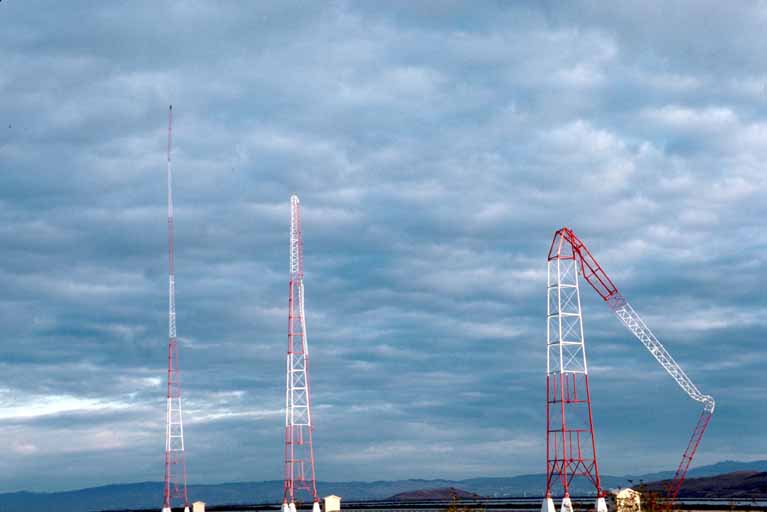
KGO Radio Tower Collapse 1989 (http://bayarearadio.org/schneider/)

Walking the dog in the rain Wednesday morning, I noticed that one leg of my 80-meter inverted Vee antenna was missing!

Trying to investigate further with a leash in one hand and an umbrella in the other, I discovered that the antenna had come undone after the wire passes through the end insulator and wraps back around itself. It is an easy fix and I will get to it this weekend.

I gathered up the pieces and wrapped the loose end of the wire around the base of my tower to get it out of the way. By the way, the bungee cord that spanned the air between the end insulator and an eye hook bored into a tree was nowhere to be found.

And for what its worth, I listened around the LW and MW bands and did not notice much of a loss of signal strength using the busted antenna with the ELAD FDM-S2 receiver.

Sunday, August 21, 2016

Still More Navigational Beacons

This symbol denotes an NDB on an aeronautical chart. (Source: Wikipedia)
I heard these new navigational beacon loggings around 0700 UTC Sunday:

QB on 230 kc transmitting 500 watts from Quebec, Quebec, 360 miles to the north

OW on 236 kc transmitting 14 watts from Ottawa, Quebec, 289 miles to the north-northwest

YVB on 243 kc transmitting 90 watts from Bonaventure, Quebec, 576 miles to the north-northeast

YLQ on 289 kc transmitting 550 watts from La Tuque, Quebec, 398 miles to the north

Y8 on 401 kc transmitting 126 watts from Drummondville, Quebec, 393 miles to the north

3U on 414 kc transmitting 85 watts from Gatineau, Quebec, 300 miles to the north-northwest

As usual lately, equipment used was an ELAD FDM-S2 receiver and 80-meter inverted Vee antenna.

Saturday, August 20, 2016

More Navigational Beacons

CA to WA1LOU
Before I went to bed last night, I tuned down the navigational beacon longwave band and logged six new ones:

BX on 220 kc transmitting 2 kW from Lourdes de Blank Salon, Quebec, 1005 miles to the northeast

QY on 263 kc transmitting 24 watts from Sydney, Nova Scotia, 718 miles to the east-northeast

YHR on 276 kc transmitting 500 watts from Chevery, Quebec, 881 miles to the northeast

NM on 278 kc transmitting 15 watts from Matagami, Quebec, 606 miles to the north-northwest

CA on 281 kc transmitting 1 kW from Cartwright, Newfoundland, 1111 miles to the north-northeast

YTA on 409 kc transmitting 13 watts from Pembroke, Ontario, 359 miles to the north-northwest

Nice thing about chasing navigational beacons is that as soon as you hear one, you can identify it because all it transmits is its callsign over and over again.

As usual lately, equipment used was an ELAD FDM-S2 receiver and 80-meter inverted Vee antenna.

Friday, August 19, 2016

F8

Victoriaville Airport
After feeding the cats at 0900 UTC, instead of going back to bed, I checked the AM band, but found nothing interesting. So I tuned to the navigational beacons and heard a half dozen beacons I had logged before including ML in Monroe, Louisiana, on 392 kc, 1232 miles away.

I heard a very weak beacon on 384 kc, so I hung in there for awhile and finally heard F8, a new logging from Victoriaville, Quebec, transmitting 25 watts, 310 miles to the north.

Equipment used was an ELAD FDM-S2 receiver and 80-meter inverted Vee antenna.

Thursday, August 18, 2016

This Day in History… Transatlantic Cable Service


Better late than never...

On August 16, 1858, the first message was sent via the transatlantic cable.

The telegraph was the first device to send messages using electricity. Samuel F. B. Morse is credited with inventing the telegraph. He first demonstrated the telegraph in 1837.

Read the rest of the story here.

Friday, August 5, 2016

8 at 0800


Instead of recording the 0900 UTC top-of-hour, I switched to 0800 UTC and logged eight new stations!

WMSA on 1340 kc in Massena, NY, transmitting 910 W, 246 miles to the north-northwest

WASR on 1420 kc in Wolfeboro, NH, transmitting 137 W, 161 miles to the north-northeast

WAZN on 1470 kc in Watertown, MA, transmitting 3.4 kW, 104 miles to the northeast

WUVR on 1490 kc in Lebanon, NH, transmitting 640 W, 145 miles to the north-northeast

WSMN on 1590 kc in Nashua, NH, transmitting 5 kW, 107 miles to the northeast

CHRN on 1610 kc in Montreal, PQ, Canada, transmitting 1 kW, 266 miles to the north

WNRP on 1620 kc in Pensacola, FL, transmitting 1 kW, 1108 to the miles SW

WPLA on 1670 kc in Dry Branch, GA, transmitting 1 kW, 845 miles to the SW

Using an ELAD FDM-S2 receiver and 80-meter inverted Vee antenna.